
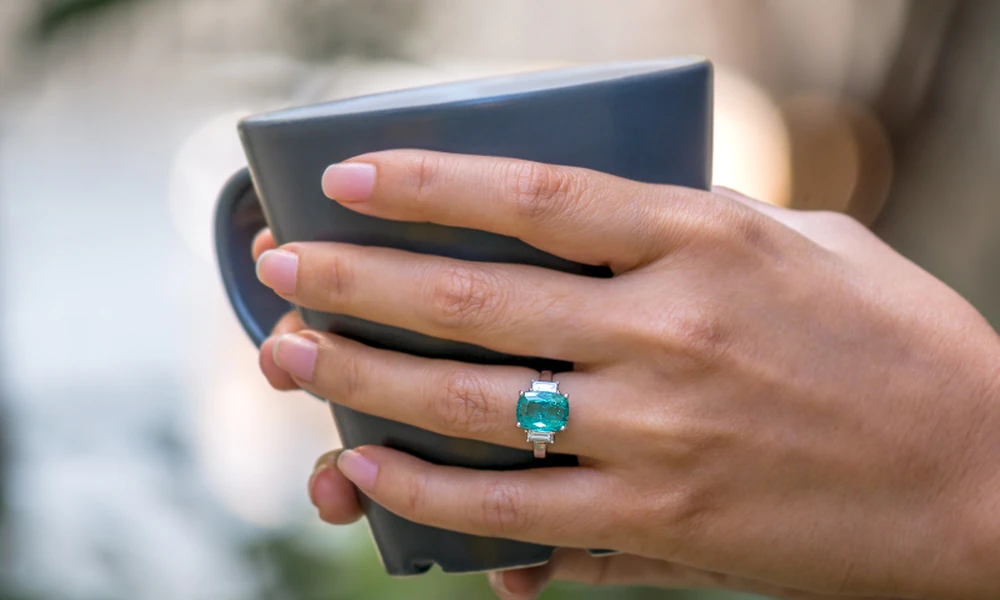
What actually happens to a ring worn every single day, through typing, cooking, gym sessions, and the hundred small knocks a hand takes without anyone noticing? That question matters more for a daily-wear ring than almost anything else, and it’s where sapphire’s reputation comes from more than its colour does.
Why Hardness Matters More Than It Sounds
On the mineral hardness scale used across the gem trade, sapphire sits near the very top, behind only diamond. In practical terms, that means a sapphire resists scratching from the everyday materials a ring brushes against constantly, kitchen surfaces, phone screens, zippers, far better than many other gemstones used in fine jewellery.
What This Means for a Ring Specifically, Versus Other Jewellery
A pendant or a pair of earrings spends most of its time away from direct contact with hard surfaces. A ring doesn’t have that luxury; hands are in constant use, which makes hardness a far more practical consideration for a ring than for almost any other piece of jewellery someone might own.
How Sapphire Compares for Everyday Wear
Will a sapphire chip if it’s knocked against something hard?
Chipping is possible with a sharp, direct impact, but it’s considerably less likely than with softer stones, and proper setting design reduces this risk further.
Does sapphire need any special care compared to other gemstones?
It’s relatively low-maintenance for its hardness level, though routine cleaning and periodic setting checks still matter, as they do with any fine jewellery piece worn daily.
Does colour affect durability at all?
No, hardness is a property of the mineral itself, not the specific colour, so a blue, pink, or yellow sapphire holds up equally well structurally.
Why Colour Still Matters, Just for a Different Reason
None of this makes colour irrelevant when choosing a sapphire ring SG buyers actually want to wear and enjoy. Durability determines how well the stone survives daily life; colour and clarity determine how much it’s genuinely loved while doing so. A durable stone in a colour that doesn’t appeal isn’t really a better choice than a well-matched colour in a reasonably durable setting.
What the Setting Still Has to Get Right
Even sapphire’s hardness doesn’t make the metal setting around it indestructible. Prongs can still bend, and a stone set too high or too exposed can still take an impact the hardness itself can’t fully absorb. A well-designed, properly fitted setting matters just as much for long-term wear as the stone’s own durability.
Why This Trade-Off Comes Up So Often in Fine Jewellery
Across fine jewellery generally, durability and appearance aren’t always aligned in the same stone; some beautiful, highly prized gemstones are genuinely more fragile than their price might suggest. Sapphire’s specific appeal for a ring is that it doesn’t force much of that trade-off; it holds up structurally while still offering a wide, often striking range of colour.
What This Means for Choosing Between Stones
For someone deciding between gemstone options specifically for a ring meant to be worn daily and for years, hardness is a reasonable first filter to apply before colour preference, simply because a stone that doesn’t hold up structurally won’t stay beautiful for long regardless of how it looked on the day it was bought.
How Metal Choice Factors Into Everyday Durability
The metal holding a sapphire in place matters almost as much as the stone itself. A softer metal can wear down at the prongs faster than the stone it’s protecting, eventually loosening the setting even though the sapphire underneath is completely unaffected. Choosing a metal suited to daily wear, rather than purely for appearance, is part of the same durability conversation as choosing the stone.
What Regular Wear Actually Looks Like Over Time
A well-chosen sapphire in a well-built setting doesn’t simply resist damage indefinitely without any attention. Periodic checks, typically once or twice a year, catch small issues like a slightly loosened prong before they become a lost stone. That modest routine, rather than the stone’s hardness alone, is usually what separates a ring still looking sharp after a decade from one that needs repeated repairs.
A sapphire ring’s reputation for lasting through daily wear isn’t really about the stone’s colour at all. It’s about a hardness that happens to come wrapped in colour, which is a genuinely useful combination for the one piece of jewellery that rarely gets a break from everyday life.
Finding a sapphire and setting combination built for genuine daily wear is easier with a direct conversation than browsing alone. Contact Yadanar Gems to find out more.
