
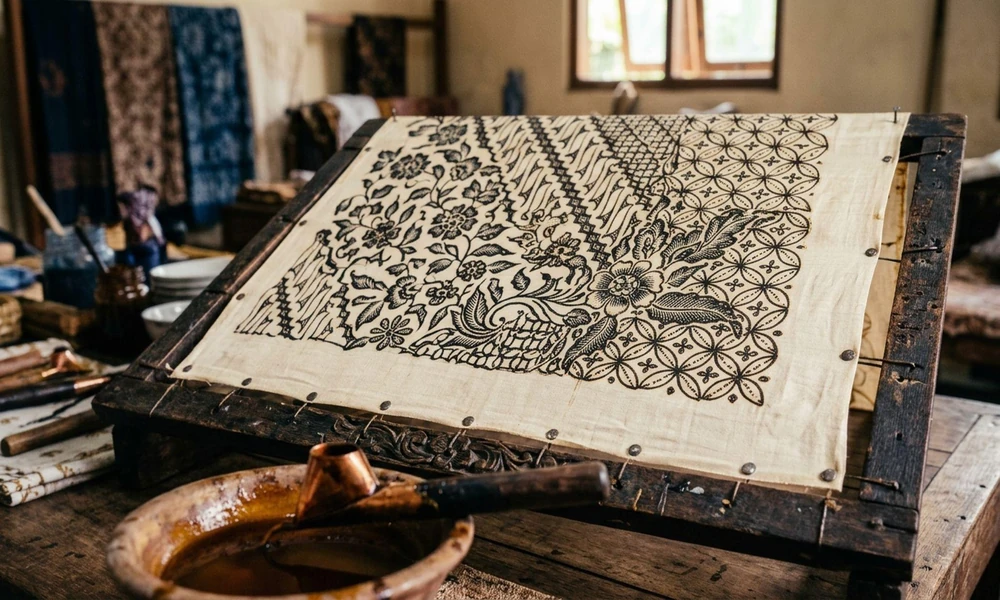
The distinction between hand-drawn and block-printed batik is often presented as a straightforward hierarchy, with one authentic and the other a lesser substitute. That framing does not survive much contact with the craft. Both are genuine wax-resist techniques with long histories, both produce excellent and poor work depending on the maker, and the choice between them depends on what a piece is for rather than which is superior. For designers and collectors sourcing batik fabric in Singapore, four factors matter more than the technique label alone.
1. How the Wax Was Applied and What That Produces
Hand-drawn work, batik tulis, is made by applying wax with a canting, a small spouted tool, line by line. The process is slow and the result carries slight variations that identify it: lines of inconsistent weight, motifs that differ subtly across a panel, and a quality of linework that cannot be mechanically repeated.
Block-printed work, batik cap, uses a copper stamp to apply wax in repeated units. It is considerably faster, produces a regular pattern, and allows larger quantities at accessible prices. Skilled cap work involves careful registration between stamps and is a craft in its own right.
The visible difference is in repetition and variation. Examining the reverse of the fabric also helps, since properly waxed batik shows the pattern penetrating to the back rather than sitting on the surface, which distinguishes both techniques from printed imitations.
2. The Base Cloth and How It Affects Everything Else
The fabric beneath the design determines how dye takes, how the piece drapes, and how it survives use. Fine cotton and silk accept dye differently, and higher thread counts hold detail that coarser cloth cannot.
Ask what the base cloth is and handle it directly. Anyone buying Peranakan batik in Singapore for garment making should consider draping alongside pattern, since a design that looks striking flat may behave quite differently once cut and sewn, and a heavier cloth suited to a wall panel often disappoints as clothing.
3. Dye Quality, Colourfastness, and How Many Dye Baths Were Involved
Multi-coloured batik requires repeated waxing and dyeing, with each colour added in sequence. The number of stages affects both cost and depth of colour.
Natural and synthetic dyes behave differently in wear and washing, and neither is automatically better. What matters is being told which was used and what care the piece requires. Ask directly about colourfastness, whether the piece has been washed after dyeing, and what washing instructions apply, since a garment that bleeds on first wash is a disappointment that a question beforehand would have avoided.
4. Motif Accuracy and the Tradition the Piece Belongs To
Peranakan batik carries a recognisable vocabulary, with particular motifs, colour palettes, and compositional conventions developed within that community’s tradition.
A piece described as Peranakan should reflect those conventions rather than borrowing the label for a generically attractive design. Asking the seller about the motifs, where the piece was made, and who tells you whether they know the tradition or are selling on aesthetics alone; a seller who can discuss provenance is usually working with makers rather than wholesalers.
Buying for the Purpose Rather Than the Label
A designer cutting several garments needs consistency across lengths and a cloth that behaves predictably, which often points toward well-executed block-printed work. A collector or someone commissioning a single significant piece has different priorities, and the variation of hand-drawn work is the point rather than a tolerance.
Handling fabric in person remains the most reliable approach, since photographs flatten exactly the qualities that distinguish good work from ordinary. When buying remotely, asking for detailed images of the reverse and a clear description of technique, cloth, and dye gives you considerably more to judge by than a product listing usually provides.
Contact Anmako Singapore to view batik in person and discuss which technique and cloth suits what you are making.
